Water is essential for human life. It accounts for for 50-70% of our body weight and is crucial for most bodily functions.1)Sawka MN, Cheuvront SN, Carter R 3rd. Human water needs. Nutr Rev. 2005 Jun;63(6 Pt 2):S30-9. doi: 10.1111/j.1753-4887.2005.tb00152.x.
Any deficit in normal body water – through dehydration, sickness, exercise or heat stress – can make us feel rotten. First we feel thirsty and fatigued, and may develop a mild headache. This eventually gives way to grumpiness, and mental and physical decline.
We continually lose water via our breath, urine, feces and skin. Most healthy people regulate their body’s water level remarkably well via eating and drinking, and are guided by appetite and thirst. But this is more difficult for infants, the sick, the elderly, athletes, and those with strenuous physical occupations, especially in the heat.2)Armstrong L. Assessing Hydration Status: The Elusive Gold Standard. https://doi.org/10.1080/07315724.2007.10719661
What happens when you dehydrate?
By the time you feel thirsty your body is already dehydrated; our thirst mechanism lags behind our actual level of hydration.
Research shows that as little as 1% dehydration negatively affects your mood, attention, memory and motor coordination.3)Lieberman HR. Hydration and cognition: a critical review and recommendations for future research. J Am Coll Nutr. 2007 Oct;26(5 Suppl):555S-561S. doi: 10.1080/07315724.2007.10719658. Data in humans is lacking and contradictory, but it appears that brain tissue fluid decreases with dehydration, thus reducing brain volume and temporarily affecting cell function.4)Biller A, Reuter M, Patenaude B, Homola GA, Breuer F, Bendszus M, Bartsch AJ. Responses of the Human Brain to Mild Dehydration and Rehydration Explored In Vivo by 1H-MR Imaging and Spectroscopy. AJNR Am J Neuroradiol. 2015 Dec;36(12):2277-84. doi: 10.3174/ajnr.A4508.
As you “lose” body water without replacing it, your blood becomes more concentrated and, at a point, this triggers your kidneys to retain water. The result: you urinate less.5)Cheuvront S et.al. Dehydration: Physiology, Assessment, and Performance Effects. https://doi.org/10.1002/j.2040-4603.2014.tb00543.x
The thicker and more concentrated your blood becomes, the harder it is for your cardiovascular system to compensate by increasing heart rate to maintain blood pressure.
When your dehydrated body is “pushed” – such as when exercising or faced with heat stress – the risk of exhaustion or collapse increases. This can cause you to faint, for instance, when you stand up too quickly.6)Lanier J. B. et.al. Evaluation and Management of Orthostatic Hypotension. https://www.aafp.org/pubs/afp/issues/2011/0901/p527.pdf
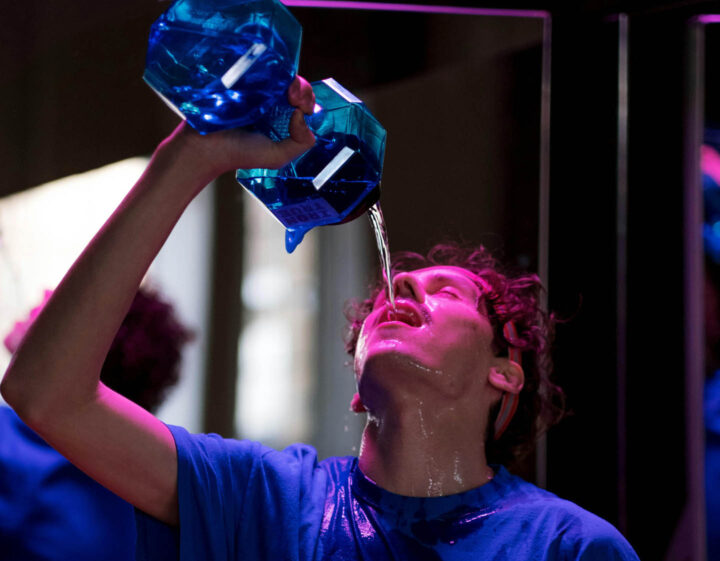
Less water also hampers the body’s attempts at regulating temperature, which can cause hyperthermia (a body temperature greatly above normal).
At a cellular level, “shrinkage” occurs as water is effectively borrowed to maintain other stores, such as the blood. The brain senses this and triggers an increased sensation of thirst.
How much should I drink?
Normal water needs range drastically due to a number of factors, such as body composition, metabolism, diet, climate and clothing.7)Sawka MN, Cheuvront SN, Carter R 3rd. Human water needs. Nutr Rev. 2005 Jun;63(6 Pt 2):S30-9. doi: 10.1111/j.1753-4887.2005.tb00152.x.
Surprisingly, the first official recommendation about water intake was made as recently as 2004. According to the Institute of Medicine, the adequate water intake for adult men and women is 3.7 and 2.7 litres per day, respectively.8)Dietary Reference Intakes for Water, Potassium, Sodium, Chloride, and Sulfate
National Academies of Sciences, Engineering, and Medicine. 2005. Dietary Reference Intakes for Water, Potassium, Sodium, Chloride, and Sulfate. Washington, DC: The National Academies Press. https://doi.org/10.17226/11964.
Around 80% of total daily water should be obtained from any beverage (including water, caffeinated drinks and alcohol!) and the remaining 20% from food.
But of course, this is just a rough guide. Here’s how to monitor your own hydration:9)Armstrong L. Assessing Hydration Status: The Elusive Gold Standard. https://doi.org/10.1080/07315724.2007.10719661
- Track your body weight and stay within 1% of your normal baseline. You can work out your baseline by averaging your weight (just out of bed, before breakfast) on three consecutive mornings.10)Comment of Redaction: Dehydration and water loss will reflect itself in your weight.
- Monitor your urine. You should be urinating regularly (more than three to four times per day) and it should be a pale straw or light yellow colour without strong odour. If less frequent, darker colour or too pungent, then drink more fluids.
- Be conscious about drinking enough fluids. Your fluid consumption should prevent the perception of thirst.

Stay Always Up to Date
Sign up to our newsletter and stay always informed with news and tips around your health.
This article is republished from The Conversation under a Creative Commons license. Read the original article.

Toby is a professor at Brock University. He teaches and researches how exercise, environmental stressors (e.g., extreme temperatures and altitude, reduced hydration, and sleep deprivation), and drugs affecting the central nervous system (e.g., stimulants and painkillers) impact the human body.
References
| ↑1 | Sawka MN, Cheuvront SN, Carter R 3rd. Human water needs. Nutr Rev. 2005 Jun;63(6 Pt 2):S30-9. doi: 10.1111/j.1753-4887.2005.tb00152.x. |
|---|---|
| ↑2, ↑9 | Armstrong L. Assessing Hydration Status: The Elusive Gold Standard. https://doi.org/10.1080/07315724.2007.10719661 |
| ↑3 | Lieberman HR. Hydration and cognition: a critical review and recommendations for future research. J Am Coll Nutr. 2007 Oct;26(5 Suppl):555S-561S. doi: 10.1080/07315724.2007.10719658. |
| ↑4 | Biller A, Reuter M, Patenaude B, Homola GA, Breuer F, Bendszus M, Bartsch AJ. Responses of the Human Brain to Mild Dehydration and Rehydration Explored In Vivo by 1H-MR Imaging and Spectroscopy. AJNR Am J Neuroradiol. 2015 Dec;36(12):2277-84. doi: 10.3174/ajnr.A4508. |
| ↑5 | Cheuvront S et.al. Dehydration: Physiology, Assessment, and Performance Effects. https://doi.org/10.1002/j.2040-4603.2014.tb00543.x |
| ↑6 | Lanier J. B. et.al. Evaluation and Management of Orthostatic Hypotension. https://www.aafp.org/pubs/afp/issues/2011/0901/p527.pdf |
| ↑7 | Sawka MN, Cheuvront SN, Carter R 3rd. Human water needs. Nutr Rev. 2005 Jun;63(6 Pt 2):S30-9. doi: 10.1111/j.1753-4887.2005.tb00152.x. |
| ↑8 | Dietary Reference Intakes for Water, Potassium, Sodium, Chloride, and Sulfate National Academies of Sciences, Engineering, and Medicine. 2005. Dietary Reference Intakes for Water, Potassium, Sodium, Chloride, and Sulfate. Washington, DC: The National Academies Press. https://doi.org/10.17226/11964. |
| ↑10 | Comment of Redaction: Dehydration and water loss will reflect itself in your weight. |
Leave a Reply