Fenugreek (Trigonella foenum-graecum) an annual plant that grows up to 20 inches in height, is a member of the pea family. The plant is native to southern Europe and southwest Asia. Today the major regions where it is cultivated include southern France, Morocco, Turkey, China, and India.

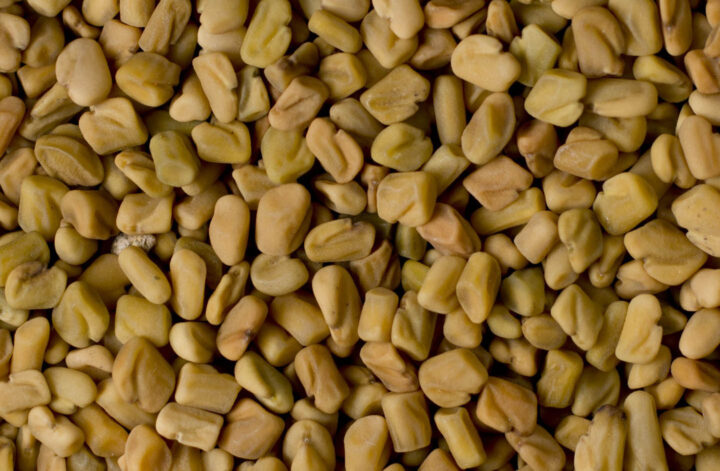
The pods of fenugreek are about four inches (10 cm) long and contain numerous seeds. The seeds which are very hard when dry, are mostly yellowish brown; some are reddish to grayish. They contain a diagonal groove that divides them into two unequal halves. The seeds are rhombic or flat diamond shaped, irregularly rounded, and about 3–5 mm long and 2–3 mm thick and wide. They are somewhat bitter and spicy, and noticeably mucilaginous when chewed. In water they swell rapidly. The ripe, dried seeds are used medicinally.
Ancient Uses
Fenugreek seeds have been used therapeutically for millennia in traditional Indian, Greek, and Arabian medicine. Ancient Egyptians used them to induce childbirth. The seeds are commonly used in Indian curries and Egyptian bread, and to prepare a hot drink.
Fenugreek has a long history of use as a digestive system remedy, as a mild laxative for gastritis, for dyspepsia, and for the loss of appetite. Others have used it to treat catarrh of the upper respiratory tract. Fenugreek also has a mild antiseptic and secretory action. It has been reported to stimulate breast milk secretion. The typical dose for its internal use is about 6 gm (a slightly rounded teaspoonful) per day.
Externally, fenugreek acts as an emollient (soothing agent), and is used as a poultice for local inflammation of the skin, boils, leg ulcers, and eczema. The poultice is prepared by soaking powdered fenugreek seeds in hot water, spreading the resulting mixture on a piece of old, soft, flannel cloth or of cotton sheeting large enough to cover the inflammation and leave one-half inch beyond on all sides. The fenugreek mixture is next covered with another similar cloth, then by a sheet of plastic wrap (a little larger than the poultice on all sides to hold moisture), and applied to the involved skin. The edges should be sealed with two-inch paper tape laid stickyside down along each edge, one-half on the plastic and one-half on the skin.
Help for Diabetics
Studies have investigated its activity in lowering cholesterol and blood sugar (glucose) in both normal and in diabetic persons. Significant reductions in total cholesterol, LDL cholesterol and triglyceride levels, but not in HDL cholesterol, have been observed in type 2 diabetics who take 25 gm (approximately 5–6 teaspoonful) of fenugreek per day. The beneficial effects were sustained over five to six months. Thus with only 5 grams of fenugreek a day, fasting and postprandial (after meal) blood glucose levels may sometimes be significantly reduced in diabetics.
With type 1 diabetics, much higher levels of fenugreek are needed to significantly reduce fasting blood glucose levels, decrease urinary glucose excretion, and daily insulin requirements, as well as reduce LDL but not HDL cholesterol and triglyceride levels. The cholesterol lowering effect of fenugreek is possibly another valuable characteristic for the diabetic who usually has elevated levels of these lipids (fats) in his blood.1)Eur J Clin Nutr, 44:301–6, 1990.
Fenugreek seeds are rich in carbohydrates, and especially a mucilaginous fiber. This soluble fiber is comprised of galactomannans, similar in properties to that of guar gum. Fenugreek also contains a variety of the phytochemicals called steroid saponins and flavonoids. All of these substances are known to lower blood lipid levels. The ability of fenugreek to improve glucose tolerance (the body’s ability to handle sugar) is probably due to its rich content of soluble fiber.
Other Effects
Healthy individuals taking five grams of fenugreek a day for three months did not experience any change in their blood lipids, or their fasting or post-prandial blood sugar levels. However, the chronic ingestion of fenugreek for three weeks did produce an improvement in blood glucose and insulin responses in healthy individuals. On the other hand, people with elevated blood cholesterol levels who consumed powdered fenugreek seeds experienced significant reductions of total and LDL cholesterol and triglyceride levels. While fenugreek is useful for lowering blood cholesterol levels it does not appear to have any effect on blood clotting.
Contraindications
While no major side effects have been reported except of occasional allergies, especially by those with other legume allergies, diabetic patients should be aware that fenugreek may interfere with other therapies that control blood sugar. Its use during pregnancy is not permitted because of its abortive effect.
Conclusions
An intake of up to 25 gm of powdered fenugreek seeds per day, or up to 2,000 mg of concentrated extract, may serve as an effective supportive therapy in the management of diabetes. Fenugreek also has useful blood lipid-lowering properties for both normal and diabetic individuals, and is helpful for loss of appetite, and externally as a poultice for local inflammations.

Stay Always Up to Date
Sign up to our newsletter and stay always informed with news and tips around your health.

Winston is Professor of Nutrition and Director of the dietetics internship program at Andrews University in Berrien Springs, Michigan, where he has taught health and nutrition classes since 1987.
References
| ↑1 | Eur J Clin Nutr, 44:301–6, 1990. |
|---|
Leave a Reply