Obviously, America is fast becoming a nation of aging people; many of them dread the possibility of losing their mental ability and sharpness even more than losing their physical ability. It reminds us of the old one liner… “As I get older I have lost a lot of things, but of all the things I have lost, I miss my mind the most.” Particularly do we fear Alzheimer’s Disease, and not without reason. Let’s look at this disease. What do we really know about Alzheimer’s Disease? What is it? Can we prevent it? How can we treat it?
By age 65, approximately 15 percent of the population experiences some degree of cognitive impairment. By age 85, dementia has increased to about 35 percent, and it continues to affect more people with further aging. About 60 to 70% of all the dementia we see is due to Alzheimer’s Disease, affecting about 7.4 million in the United States. Globally, it is estimated that over 55 million people live with dementia, expected to reach 130 million by 2050.
The duration of Alzheimer’s Disease may be as long as 20 years or more from the time of diagnosis until death, but the average time is thought to be 4 to 8 years, and the particular pattern of development in individual cases can be very different.
One of the saddest things about this dementia is that people in its early stages are quite aware that something is wrong. The collective awareness of America regarding this disease was markedly increased when Ronald Reagan announced in November, 1994, that he had been diagnosed with Alzheimer’s Disease. Those who have watched as closely as possible the progress of his disease see a fairly sad spectacle—one who was once the leader of the free world reduced to an individual who does not even recognize his family.
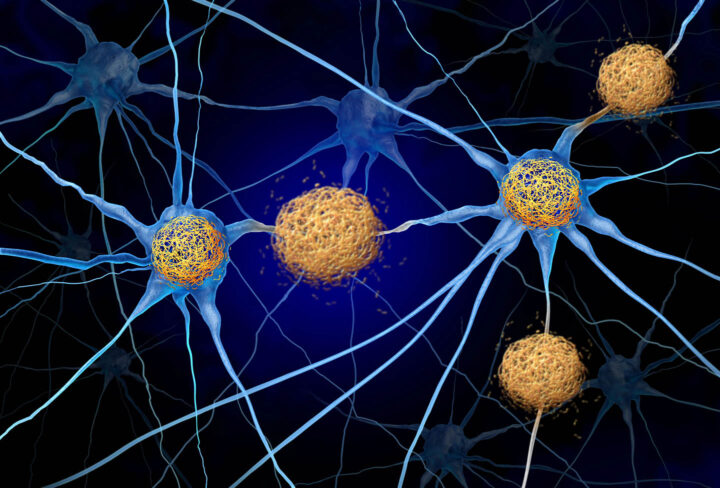
In spite of increasing knowledge about Alzheimer’s Disease, we still don’t know what causes it, how to prevent it, or what to do about it when we do get it. So what do we know? What is happening in the brain in Alzheimer’s Disease? A certain protein in brain nerves is not processed properly by the brain cells, especially in the hippocampus and cerebral cortex, and gets stuck between and inside of brain cells. The protein is called “beta-amyloid protein.” Pieces of this form strange-looking structures called “beta-amyloid plaques.” Meanwhile, inside the brain cells, a completely different defective protein forms “neurofibrillary tangles.” Then, to complicate matters further, some of this beta-amyloidal protein inside the center of the plaque is surrounded abnormally by slender message-carrying arms from other nerve cells next door. Sounds like a set-up for message foul-up or loss, which it probably is.
Scientists know that the piece of beta-amyloid protein that gets stuck between cells is clipped off by some enzymes into either a 3-part or a 40-part segment. This is normal, and no problem. “Apo-protein” (particles of protein that transport some fats in the blood) carries away the 40-segment portion, and there is no problem. But people with a ApoE4 mutation have problems to clear out another 42 segment aminoacid. These 42-segment portions accumulate, and become the beta-amyloid plaques.
Just how does the beta-amyloid do its damage? In several ways, it seems. It may increase the development of free radicals, with resulting inflammation. In transmission of a message from one cell (cell #1) to another (cell #2), it may prevent signal-receiving molecules in the membrane of cell #2 from sending on the message that they need more acetylcholine (ACh) right away. Acetylcholine is one of the most significant chemical messengers in the brain. Transported in little sacs called “vesicles,” it carries a message from the axon of one cell to a receiving area in the membrane of the next cell. Thus the brain cell that needs to be activated, is not. Actually, a very marked drop in ACh occurs in the brains of patients with Alzheimer’s Disease. There is some drop in ACh in normal aging, but in Alzheimer’s Disease patients it drops up to 90 percent! To repeat, the drop in ACh markedly decreases the communication of a message from cell to cell.
As ACh travels down the axon of the first cell, it seems to move in specific channels, or little tubes that constitute the support structure or framework of the cell, as well as carry not only the ACh-containing vesicles, but also cell nutrients. In Alzheimer’s Disease these neuro-tubules seem to be messed up because a “Tau protein” that should keep them in proper arrangement does not bind to them properly, and forms the thread- like neuro-fibrillary tangles, thus blocking transport of both vesicles and nutrients. Cells deteriorate and die, and the brain shrinks.
As we said, we don’t know why all this happens or what to do about it. But we do have some clues—especially identification—of some apparent risk factors.
However, the risk factors are just that- factors that increase the risk of an event taking place. They may, but do not necessarily, prove to be causes. Perhaps they are only associated matters (markers) that, along with the Alzheimer’s Disease, are related to some other common cause as yet not identified. With this caution in mind let’s take a look at some of these risk factors.
Certain sociological elements seem to be involved. For example, some studies have looked at the difference between individuals who grew up in a rural environment and those who grew up in an urban environment. African Americans who grew up in rural areas of the southern states and obtained less education, seem to have much higher levels of Alzheimer’s Disease. It also seems to be more prevalent in large families with multiple siblings, in which the risk of Alzheimer’s Disease goes up significantly. In families with five or more siblings, the risk of Alzheimer’s Disease is 39 per- cent greater. Might this reflect a competition for nourishment early in life, even from before birth, to later on?
Marital status also seems to have some effect. Married people have less likelihood of developing Alzheimer’s Disease than those who have never been married. Even those who have married and then divorced have a lower risk than those who have never married-thus, there does appear to be a protective benefit in marriage.

Genetics
Obviously, a genetic, or hereditary factor may be involved. Studies of siblings, and especially twins, are a fruitful source of information. Estimates of relationship vary from 1 percent to 75 percent. Probably about 50 percent is most universally accurate. As science looks more deeply into the mechanism of heredity, more is continually being discovered about the function of various genes. As you know, the code for individual personal characteristics is carried in genes on chromosomes, sort of like beads in a necklace. There are two strings of paired genes, and each gene pair has one gene from mother and one from father.
It is not unusual for individual genes to have several different forms. These are called “alleles”. As of now, dozens of genes have been definitely associated with Alzheimer’s Disease. Not but one, the ApoE gene, has been fully explored, but the ApoE gene, has been more deeply studied. The most common form is the E3; the E4 is the most uncommon. Fortunately, it is the E4 that seems to be most closely associated with development of Alzheimer’s Disease. Carrying two copies of the E4 variety can increase an individual’s risk by up to 12 to 15 times. Looks suspicious, doesn’t it!
Each of us has 2 Apo genes, one from each parent. Obviously, if both parents have ApoE4, the risk of one’s developing Alzheimer’s Disease is greater. Fortunately, only 2 percent of the general population has double E4 alleles. However, this 2 percent is related to 15 percent of Alzheimer’s Disease cases. People with only 1 E4 allele make up 20 percent of the population, but up to 50 percent of Alzheimer’s Disease cases. Certainly, there is a very significant association between ApoE4 and Alzheimer’s Disease!
It appears that the ApoeE4 gene may be more predictive of when one gets the disease, rather than if. Symptoms occur in people with both genes by age 80 to 85, if at all. If only one allele is present, onset is delayed to age 90 to 95. If no E4 genes, symptoms would begin to appear between age 95 to 100. The individual may likely die of something else first.
We are not quite sure what is going on with this particular allele, but we think that it is not necessarily that the E3 and E2 are protective, although some of the studies seem to suggest that. Rather, it may be that they are more efficient in the job they are doing than the E4 variety, making them look somewhat protective.
Dietary Factors
What about diet? Studies of dietary factors indicate that this ApoE4 gene is also influenced by diet. So just having the gene does not necessarily doom you to a problem. Studies find that individuals with this gene who had a high fat diet may actually have a seven times greater risk than those with the gene but who get a low fat diet! If you are unfortunate enough to have the ApoE4, you are much better off with a low fat diet!

Researcher William Grant studied this whole relationship between fat intake and Alzheimer’s Disease. Data from 11 countries around the world indicated that the greater the average fat supply per person, the more Alzheimer’s Disease. Here again we must remember that this association does not prove cause-only risk factors.
Taking that a little step further, the Rotterdam study in Holland looked at over five thousand individuals. It made individualized dietary recall records on these individuals, and then compared them with the risk of dementia based on the various intakes of fat in their diet. The risk is almost two and a half times higher in those who had a high fat diet.
Saturated fat and cholesterol also seemed to elevate the risk. But interestingly enough, having a diet high in fatty fish seems to be protective, so this seems to indicate that it may not be just the fat content itself that is the problem, but rather we need to look at the type of fat. Possibly the omega 3 fatty acids are protective or at least not as damaging as the other PUFAs (polyunsaturated fats). This is true for other disease states also, particularly heart disease.
Vegetarians need to note these facts because in a vegetarian diet we tend to promote a ratio of omega 6 to omega 3 in the wrong direction.
Levels of homocysteine (a risk factor for atherosclerosis) in the blood are important. One study found that people whose blood levels were in the highest category (tertile) had four-and-a-half times the risk for getting Alzheimer’s Disease as did those in the lowest category. Whether this risk is specifically related to homocysteine itself, or to too-low levels of vitamin B12 or folic acid and/or possibly other B vitamins is not known.
What about per capita food consumption? Yes, caloric restriction is associated with less incidence of Alzheimer’s Disease, and the relationship like others, is direct—the greater the average amount of food eaten, the more the Alzheimer’s Disease. And the less, the less. This could be related to the fact that in some countries with lower per capita food consumption, the lifespan is shorter. So, once again, it doesn’t prove causation.
Some intriguing lab work relating to stress has been done in rats. On a normal diet, rats exposed to some toxic event or poisonous chemicals lost 50 – 60% of their neurons. But when that same group of rats was fed a diet restricted by forty percent and exposed to that same neurotoxin challenge, only nine percent of their neurons were lost. So, there does appear to be some neurological advantage to caloric restriction.
Other Negative Factors
Medical histories of people who have suffered severe head trauma show that these people are more than two times as likely to develop Alzheimer’s Disease later on in life. The early damage may be causing some of the problem.
A relatively small study of nineteen subjects reports an interesting association with infectious disease. When the brains of the nineteen Alzheimer’s Disease patients were examined, seventeen had the antibody to and evidence of chlamydia pneumonia bacteria in the brain. Only one of the non-Alzheimer’s Disease controls had had that particular exposure.
Because chlamydia is so prevalent in the general population, this may or may not be significant.
Oxidative Stress
At first glance there doesn’t appear to be any relationship among these items. However, when we study them a little more carefully, we find that almost every one of these particular events or risks seems to point to oxidative stress! What is that? Normal processes of aging cause production of free radicals, very active particles that damage normal tissues. In most cases a fairly rapid repair process takes care of free radical damage. But as we age, that repair process becomes less efficient and so there is more and more damage.
A free radical agent that has damaged one single molecule in a lipid membrane opens the door to the destruction, on the average, of 26 molecules in that lipid membrane!
Each cell in your body probably gets 10,000,000 or more hits a day from free radicals or similar sources—it is no wonder that some damage occurs.
Causes of free radical formation run all the way from sunlight to the metabolic processes, the changes that take place just from living. A number of the things that we are exposed to every day certainly can increase the likelihood of damage. Tobacco smoke, pesticides, cured meat, infections, all elevate the amount of injury that occurs from free radicals. In most cases, however, it is either from the direct or indirect effect of toxins. Are these effects produced by bacteria or from the environment that man has introduced?

Because cell membranes contain many lipid molecules, oxidative damage is much more significant in older people.
Antioxidants [found in many naturally occurring beneficial plant chemicals] stop free radical damage.
Suggestions for Therapy
If we are going to try to intervene to reduce free radical damage we have a number of choices. The one that is most normally forgotten is that we can reduce their formation in the first place by:
- avoiding exposure to tobacco smoke,
- avoiding environmental pollution,
- avoiding cured meats and other things that increase the likelihood of free radical formation.
Second: enhance the body’s natural defenses and, finally, supplement with antioxidants if necessary.
What About Supplements?
Supplemental Antioxidants
Remembering that antioxidants actually become free radicals themselves, and need to be regenerated or get their electron back, we need to realize that they are not isolated from one another, but are really a network or a system. Vitamin C reacts with Vitamin E to regenerate the Vitamin E radical so it can be effective again. Vitamin C now becomes a free radical. It needs to be regenerated, primarily from food. So you have this whole system that needs to be in balance. If you start taking too much Vitamin C or too much Vitamin E without keeping them in proportion, you destroy the delicate balance of the antioxidant network. In some cases Vitamin C, for example, can actually become an oxidative agent rather than something that actually benefits and prevents free radical generation! We need, then, to do anything we can do to reduce free radical production and/or damage. When you look at the things that seem to be effective, they all tend to fall into that category.
Herbal Supplements
Everybody wants some sort of supplement that will make a difference. One study looked at gingko biloba, which is thought of as a “brain food.” It appears that it has a modest effect. Individuals who were treated for 26 weeks with a 120 mg daily dose of gingko, experienced a 30 percent improvement in their mental ability; the placebo group had a 25 percent improvement. This difference may or may not be particularly significant. Other studies were though inconclusive on this matter. Taking a little gingko every day may not be that bad of an idea.

Some work has also been done with another plant-based compound called huperzine which shows some fairly significant effects. Alzheimer’s patients who took this herbal preparation demonstrated an improvement in their clear-headed thinking, their memory, and their language. The number of those who were unchanged decreased. This effect remained when compared with a commonly used medication for treating Alzheimer’s Disease. The herbal preparation actually looked better than the drug that was being used.
Mental Stimulation
Mental stimulation seems to make a huge difference. Studies have shown that one hour of mental exercise a day in Alzheimer’s Disease patients actually improves their cognitive ability significantly! If we can keep them mentally active, it is certainly going to make a difference. Other studies show that individuals who have higher levels of education or who have been mentally active in the early years of their life seem to be protected and are not as likely to experience the disease as early or as severely as others.
Exercise
Exercise also seems to make a difference. Sedentary adults over 60 years old began to walk on a regular basis. Their mental ability markedly increased. And this is interesting, because the comparison group did exercises-non-aerobic kinds of exercises, where they did stretching or a yoga kind of thing. Their mental ability did not improve. The actual physical movement of walking seemed to make a difference.
Some Straws in the Wind…
It appears that folate, B12, and B6 in particular, are protective, keeping the homocysteine levels down, and improving mental sharpness. Those who eat higher levels of omega-3 are somewhat protected.
The Last Word
Preliminary data from studies at Case Western Reserve University looking at antioxidant intake and Alzheimer’s Disease look very promising. These studies compare Alzheimer’s Disease patients and controls, looking at their recall of their diets in earlier life. Of course, much depends on their recall. But it appears that the individuals without Alzheimer’s Disease were more likely to have high intakes of these specific antioxidants in their diet: Vitamin A, alpha carotene, beta carotene, provitamin A, lutein, and lycopene-all fairly powerful antioxidants. Certainly, the many factors involved indicate that, like heart disease and stroke, Alzheimer’s Disease may be largely a lifestyle disease, and attention to behavior, or even diet, in your 30’s or 40’s, may allow you to avoid Alzheimer’s Disease decades later.

Stay Always Up to Date
Sign up to our newsletter and stay always informed with news and tips around your health.
This article was published originally in the Journal of Health and Healing, a publication of Wildwood Institute.

Dr. Bix was assistant to the Dean for Special Projects, School of Public Health, Loma Linda University, Loma Linda California.
Leave a Reply