Every year, according to the National Institutes of Mental Health, about 11 million Americans suffer mild cases of depression and another 10 million suffer mild to severe depression. St. John’s Wort (Hypericum perforatum) has received increasing attention as a safe product that provides some natural relief from depression.
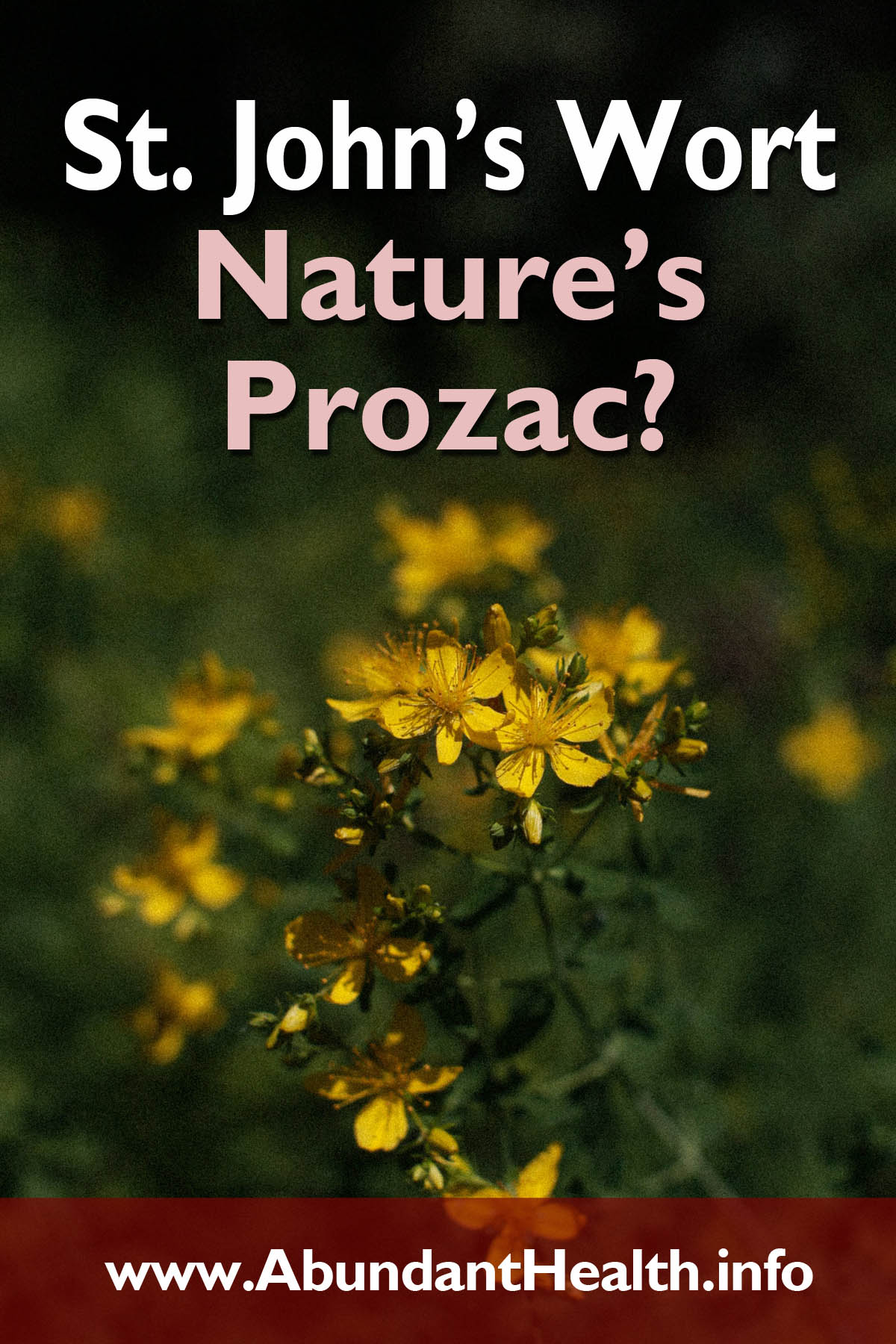
St. John’s Wort is a perennial herb that grows up to three feet tall in neglected fields and alongside country roads throughout North America and Europe. The erect, many-stemmed herb is topped with a cluster of bright yellow, star-shaped flowers (with five slightly asymmetrical petals) that bloom from June to August. There are numerous explanations as to how St. John’s Wort received its name. The preferred explanation refers to the fact that the flowers bloom around June 24 (St. John’s Day), while another refers to an ancient tradition of throwing the flowers into a bonfire on the eve of St. John’s Day. The word “wort” is an old English word for plant.
Anciently St. John’s Wort was used to treat neuralgic conditions such as sciatica and hip pain. In nineteenth-century America, St. John’s Wort was used for healing wounds and as a diuretic. Hypericum was also highly valued for its sedative properties. Herbalists today recommend it to treat wounds and to speed the healing of bruises and minor burns. Historically it has been one of the most dependable botanicals for the treatment of wounds. Today it is also highly prized as an antidepressant, without the side effects of conventional antidepressant drugs.
The dried herb usually consists of the flowering tops, unopened buds, and uppermost leaves of the plant. It has a slightly sweet and aromatic odor and a mildly bitter, somewhat astringent taste. When ground into a powder, it is usually greenish to yellowish-brown in color. When more flowers and buds are used, the mixture is more yellow.
Clinical Trials
The analysis of two dozen clinical trials involving over 1,700 outpatients revealed that St. John’s Wort given for 48 weeks’ duration can be considered a safe and effective herb for the treatment of mild depression and anxiety. It has an activity comparable to that of conventional antidepressants, such as Prozac, but with fewer side effects. The common side effects experienced with the conventional antidepressants include nausea and dizziness, sleeplessness, reduced sexual drive, headaches, dry mouth, and loss of appetite.
The people who took St. John’s Wort in the various clinical trials experienced significant improvement in depressive mood indicators such as feelings of sadness, hopelessness, helplessness, and fearfulness. Sleep difficulties and disruptive sleep patterns were also greatly improved after taking St. John’s Wort.

Among other useful herbs are licorice root, which has some useful antidepressant compounds, and rosemary, a real favorite. This contains cineole, which stimulates the central nervous system. Valerian and hops are herbs that provide useful sedative properties and can be used for their sleep-promoting action.
Hypericum contains several active compounds, including a variety of phenolics, terpenoids, and sterols. It is rich in flavonoids as well as naphthodianthrones, hypericin, and pseudohypericin. Hypericin in particular seems to be a monoamine oxidase (MAO) inhibitor,1)“In combination with certain foods and drugs, MAO inhibitors may cause dangerously increased blood pressure. Symptoms include headache, stiff neck, nausea, vomiting, and clammy skin. In recommended amounts, St. John’s Wort is not as powerful as pharmaceutical MAO inhibitors. Nonetheless, those using the herb should follow certain precautions.” Castleman, M. The Healing Herbs, p. 324, Rodale Press, Emmaus, PA, 1991. which places it among a class of chemicals known to be antidepressant. However, the antidepressant activity of St. John’s Wort may be due to more than just hypericin and may be partly due to other minor constituents in the plant. Clearly, the best procedure is to consume the total herbal product and not just a hypericin-rich extract. The antimicrobial activity of Hypericum is attributed to the essential oil, phloroglucinols, and flavonoids.
Herbal Preparations
Recommendations for the use of the herb usually include drinking 1-2 cups per day of herbal tea made from 1-2 teaspoons of dried St. John’s Wort flowers steeped in a cup of boiling water for 10 minutes. Alternatively, a 300 mg capsule standardized to contain 0.3 percent hypericin may be used up to three times a day. Normally, it takes about 36 weeks of regularly using St. John’s Wort before its therapeutic effects are observed. High doses or prolonged use may sensitize the skin to sunlight exposure since hypericin has photodynamic properties.
Other Activities
St. John’s Wort has been shown to increase the storage levels in one’s body of the two neurochemicals, serotonin, and norepinephrine. Serotonin is known to be a mood-altering substance, normally producing a calming effect. Research has revealed that other components of St. John’s Wort alter the levels of interleukin-6, which may also alter mood. Heinze and Gobel reported in 1996 that Hypericum may be useful in the treatment of chronic tension-type headaches.
In another study, researchers observed that extracts of St. John’s Wort given over a three-week period caused a significant increase in the production of nocturnal melatonin, a substance produced by the pineal gland that regulates circadian rhythms.
Recently, interest has focused on the antiviral activity of St. John’s Wort. Substantial activity against several retroviruses has been reported. St. John’s Wort has been even researched for its potential usefulness in treating HIV-infected patients.
Conclusion
St. John’s Wort is clearly one of the leading plant medicinals for the treatment of mild to moderate depression. Studies are needed to determine its effectiveness and safety in long-term usage. It has been suggested for the treatment of more severe forms of depression, but controlled clinical trials are lacking at this time. In addition to its antidepressant effects, Hypericum has been used for a wide variety of neurological conditions such as anxiety, insomnia, irritability, migraine headaches, and chronic neuralgia stemming from trauma and injuries. Furthermore, Hypericum is useful as a wound-healing agent, an anti-inflammatory and antiviral agent, and for the treatment of ulcers, inflammatory bowel syndrome, hemorrhoids, and herpes lesions.

Stay Always Up to Date
Sign up to our newsletter and stay always informed with news and tips around your health.
This article was published originally in the Journal of Health and Healing, a publication of Wildwood Institute.

Winston is Professor of Nutrition and Director of the dietetics internship program at Andrews University in Berrien Springs, Michigan, where he has taught health and nutrition classes since 1987.
References
| ↑1 | “In combination with certain foods and drugs, MAO inhibitors may cause dangerously increased blood pressure. Symptoms include headache, stiff neck, nausea, vomiting, and clammy skin. In recommended amounts, St. John’s Wort is not as powerful as pharmaceutical MAO inhibitors. Nonetheless, those using the herb should follow certain precautions.” Castleman, M. The Healing Herbs, p. 324, Rodale Press, Emmaus, PA, 1991. |
|---|
Leave a Reply