A bit of stress can be good for your mental and physical well-being,1)Seery MD, Holman EA, Silver RC. Whatever does not kill us: cumulative lifetime adversity, vulnerability, and resilience. J Pers Soc Psychol. 2010 Dec;99(6):1025-41. doi: 10.1037/a0021344. but too much can lead to anxiety, depression and other health problems.2)Jude Mary Cénat, et. al. Prevalence of symptoms of depression, anxiety, insomnia, posttraumatic stress disorder, and psychological distress among populations affected by the COVID-19 pandemic: A systematic review and meta-analysis, Psychiatry Research, Volume 295, 2021, 113599, ISSN 0165-1781, https://doi.org/10.1016/j.psychres.2020.113599. It can also make you age faster. So learning to become more stress-resilient is important if you’re not in a hurry to grow old fast.3)Epel ES. The geroscience agenda: Toxic stress, hormetic stress, and the rate of aging. Ageing Res Rev. 2020 Nov;63:101167. doi: 10.1016/j.arr.2020.101167. Epub 2020 Sep 28. PMID: 32979553;
Studies have shown that people who aren’t good at managing their stress can increase their risk of dying prematurely by 43%. The increase in deaths might in part be due to the effect stress has on DNA.4)Keller A, Litzelman K, Wisk LE, Maddox T, Cheng ER, Creswell PD, Witt WP. Does the perception that stress affects health matter? The association with health and mortality. Health Psychol. 2012 Sep;31(5):677-84. doi: 10.1037/a0026743.
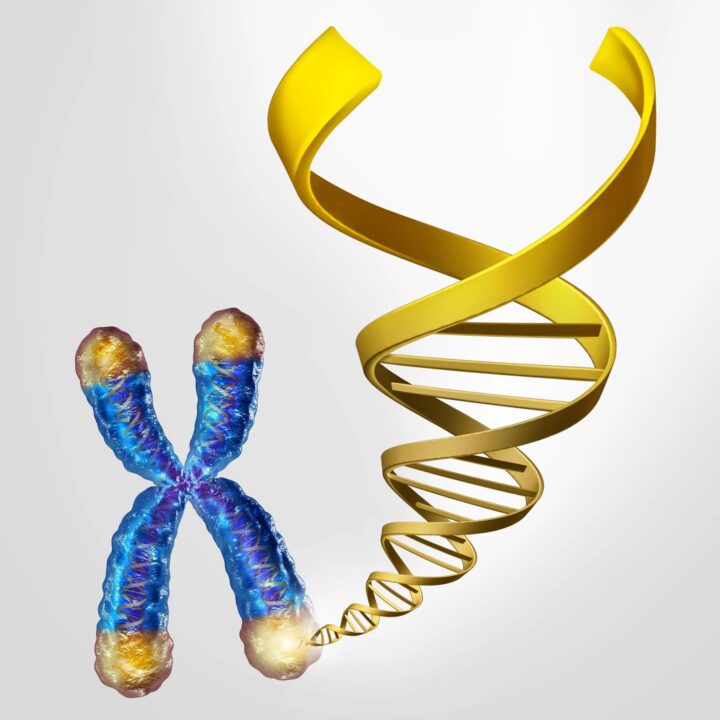
DNA, which is found in nearly every cell (except red blood cells), contains genes that code for the building blocks (proteins) that comprise your body. DNA consists of two strands woven together in the famous “double helix”. Your cells are constantly making copies of themselves, and when a cell divides, the two strands unravel and an identical copy is made of each – well, most of the time.
Sometimes mistakes happen during the replication process, especially at the end of DNA strands. These mistakes can cause mutations in the copied DNA, leading to the cell becoming cancerous. Luckily, cells have protective caps called telomeres at the ends of the DNA strand that are designed to ensure these mistakes don’t happen.
Telomere caps are like sequences of beads (telomeric repeats). Each time the cell divides, the next generation loses one bead of telomeric repeats.5)Gomez, D.E., Armando, R.G., Farina, H.G., Menna, P.L., Cerrudo, C.S., Ghiringhelli, P.D., & Alonso, D.F. (2012). Telomere structure and telomerase in health and disease (Review). International Journal of Oncology, 41, 1561-1569. https://doi.org/10.3892/ijo.2012.1611 Unfortunately, each cell has a fixed number of these repeats, meaning that it can only replicate a certain number of times before the protective telomere caps are eroded. This number of cell divisions is called the Hayflick limit.6)Shay, J., Wright, W. Hayflick, his limit, and cellular ageing. Nat Rev Mol Cell Biol 1, 72–76 (2000). https://doi.org/10.1038/35036093 Once a cell reaches the Hayflick limit (up to 60 cell divisions, for most cells), it self-destructs safely. This is the essence of aging.7)Bartlett, Zane, “The Hayflick Limit“. Embryo Project Encyclopedia ( 2014-11-14 ). ISSN: 1940-5030 https://hdl.handle.net/10776/8237
Some cells in the body, especially the immune cells that fight infection, possess molecules called telomerase. Telomerase can add the beads back (telomeric repeats) in immune cells (and some others, such as cancerous cells), meaning that aging can be reversed in these cells.8)Gomez, D.E., Armando, R.G., Farina, H.G., Menna, P.L., Cerrudo, C.S., Ghiringhelli, P.D., & Alonso, D.F. (2012). Telomere structure and telomerase in health and disease (Review). International Journal of Oncology, 41, 1561-1569. https://doi.org/10.3892/ijo.2012.1611
This makes sense as immune cells have to replicate many times to fight viruses and bacteria. Without telomerase, they would reach their Hayflick limit and disappear, leaving organisms with no protection. Unfortunately, however, even telomerase stops working properly when people reach their 80s and lose their immune cells to aging.9)Andrews N P. et.al. Telomeres and Immunological Diseases
of Aging. Gerontology 2010;56:390–403 DOI: 10.1159/000268620
It’s not all beyond your control
Smoking, excess alcohol consumption, being overweight and stress are all associated with telomere loss.10)Espinosa-Otalora, Raul & Villamizar, Jairo & Esteban-Pérez, Clara & Forero, Maribel & Marin Suarez, Johana. (2020). Lifestyle effects on telomeric shortening as a factor associated with biological aging: A systematic review. Nutrition and Healthy Aging. 6. 1-9. 10.3233/NHA-200096. http://dx.doi.org/10.3233/NHA-200096 Telomerase does not work as efficiently when a person suffers from excessive stress, and this causes premature aging.
Adopting a healthy lifestyle, such as eating a plant-based diet, can stop and even reverse the process.11)Solway J, McBride M, Haq F, Abdul W, Miller R. Diet and Dermatology: The Role of a Whole-food, Plant-based Diet in Preventing and Reversing Skin Aging-A Review. J Clin Aesthet Dermatol. 2020 May;13(5):38-43. Epub 2020 May 1. PMID: 32802255; And physical activity, especially intense exercise, can also increase telomerase activity.12)Joshua Denham, Maha Sellami,
Exercise training increases telomerase reverse transcriptase gene expression and telomerase activity: A systematic review and meta-analysis, Ageing Research Reviews, Volume 70, 2021, 101411, ISSN 1568-1637, https://doi.org/10.1016/j.arr.2021.101411. So leading a healthy life can decrease the speed of aging as can managing your stress.

As we mentioned earlier, not all stress is bad. In psychology, we differentiate between “eustress” (positive stress), which is necessary for us to succeed at work, in sport and relationships, and “distress” (negative stress), when pressure becomes too much for us to manage. Distress is what most of us mean when we say or feel that we are stressed; it is also what might speed up aging in your cells.
So there is no need to protect yourself from all stress, only the distress that lasts for a long time, is relentless and prevents you from living your life to the full.13)Nina Vindegaard, Michael Eriksen Benros,
COVID-19 pandemic and mental health consequences: Systematic review of the current evidence, Brain, Behavior, and Immunity, Volume 89, 2020, Pages 531-542, ISSN 0889-1591, https://doi.org/10.1016/j.bbi.2020.05.048.
Embracing stressful events and using coping strategies such as seeking help from friends or becoming resourceful when dealing with challenges, can create stress resilience, which in turn is associated with longer telomeres.14)Johnson AJ, et. al. Resilience factors may buffer cellular aging in individuals with and without chronic knee pain. Mol Pain. 2019 Jan-Dec;15:1744806919842962. doi: 10.1177/1744806919842962. Also, reappraising an anxiety-provoking event, such as taking on a public speaking engagement, by perceiving it as exciting can help you to manage stress. These techniques can stop eustress from becoming distress and enhance stress resilience.

Resilience is the ability to bounce back after adversity and become resistant to daily stressors. Besides problem-solving, social support and effective use of coping strategies, present moment awareness can also help you become more resistant to daily stressors.15)James N. Donald, Paul W.B. Atkins, Philip D. Parker, Alison M. Christie, Richard M. Ryan, Daily stress and the benefits of mindfulness: Examining the daily and longitudinal relations between present-moment awareness and stress responses, Journal of Research in Personality, Volume 65, 2016, Pages 30-37, ISSN 0092-6566, https://doi.org/10.1016/j.jrp.2016.09.002.
Other techniques include doing things that enhance your positive emotions, such as reading a book, listening to music, or playing a computer game.16)Tugade, M.M., Fredrickson, B.L. Regulation of Positive Emotions: Emotion Regulation Strategies that Promote Resilience. J Happiness Stud 8, 311–333 (2007). https://doi.org/10.1007/s10902-006-9015-4 Experiencing positive emotions broadens your mind, allowing you to perceive and draw from your psychological, intellectual and social resources, especially when experiencing adversity.17)Fredrickson BL. The broaden-and-build theory of positive emotions. Philos Trans R Soc Lond B Biol Sci. 2004 Sep 29;359(1449):1367-78. doi: 10.1098/rstb.2004.1512.
We can’t yet be sure that these psychological strategies affect telomeres and by extension the aging process. However, telomere length and telomerase activity in your cells do seem to be negatively affected by stress and positively affected by stress management.18)Espinosa-Otalora RE, Flórez-Villamizar J, Esteban-Pérez CI, Forero-Castro M, Marín-Suarez J. Lifestyle effects on telomeric shortening as a factor associated with biological aging: A systematic review. Nutrition and Healthy Aging. 2020;6(2):95-103. doi:10.3233/NHA-200096 So if you have lifestyle changes you can make to help you develop stress resilience, you might want to adopt them. They might not make you live as long as an Arctic shark, but they could add some precious years onto your life.19)Butler P. A 400-year-old shark is the latest animal discovery to reveal the secrets of long life. The Conversation, August 11, 2016
Do you need a guide to help you understand how to cope with Stress in an all inclusive approach? Learn how to combat stress, mentally, physically, emotionally and strategically in your life.

This article is republished from The Conversation under a Creative Commons license. Read the original article.


Prof. Jolanta Burke is a Chartered Psychologist and an award-winning researcher at the Centre for Positive Health Sciences at RCSI University of Medicine and Health Sciences. She is a Programme Director for Masters in Applied Positive Psychology (Wellbeing and Health), Programme Co-director for Masters in Positive Health Coaching and a Research Lab Founding Director of the Positive Activity Lab at RCSI. She has been writing for the Guardian, Irish Independent, Psychology Today and other publications.

Dr Pádraic Dunne (PhD) is an immunologist, practicing psychotherapist, accredited senior coach and certified lifestyle medicine professional, based at the Centre for Positive Health Sciences (CPHS), Royal College of Surgeons in Ireland (RCSI), University of Medicine and Health Sciences. As a Senior Lecturer, and lead researcher of the Digital Health Research Group, Pádraic is interested in the development of health coach-led online health and well-being programs for the public.
References
| ↑1 | Seery MD, Holman EA, Silver RC. Whatever does not kill us: cumulative lifetime adversity, vulnerability, and resilience. J Pers Soc Psychol. 2010 Dec;99(6):1025-41. doi: 10.1037/a0021344. |
|---|---|
| ↑2 | Jude Mary Cénat, et. al. Prevalence of symptoms of depression, anxiety, insomnia, posttraumatic stress disorder, and psychological distress among populations affected by the COVID-19 pandemic: A systematic review and meta-analysis, Psychiatry Research, Volume 295, 2021, 113599, ISSN 0165-1781, https://doi.org/10.1016/j.psychres.2020.113599. |
| ↑3 | Epel ES. The geroscience agenda: Toxic stress, hormetic stress, and the rate of aging. Ageing Res Rev. 2020 Nov;63:101167. doi: 10.1016/j.arr.2020.101167. Epub 2020 Sep 28. PMID: 32979553; |
| ↑4 | Keller A, Litzelman K, Wisk LE, Maddox T, Cheng ER, Creswell PD, Witt WP. Does the perception that stress affects health matter? The association with health and mortality. Health Psychol. 2012 Sep;31(5):677-84. doi: 10.1037/a0026743. |
| ↑5, ↑8 | Gomez, D.E., Armando, R.G., Farina, H.G., Menna, P.L., Cerrudo, C.S., Ghiringhelli, P.D., & Alonso, D.F. (2012). Telomere structure and telomerase in health and disease (Review). International Journal of Oncology, 41, 1561-1569. https://doi.org/10.3892/ijo.2012.1611 |
| ↑6 | Shay, J., Wright, W. Hayflick, his limit, and cellular ageing. Nat Rev Mol Cell Biol 1, 72–76 (2000). https://doi.org/10.1038/35036093 |
| ↑7 | Bartlett, Zane, “The Hayflick Limit“. Embryo Project Encyclopedia ( 2014-11-14 ). ISSN: 1940-5030 https://hdl.handle.net/10776/8237 |
| ↑9 | Andrews N P. et.al. Telomeres and Immunological Diseases of Aging. Gerontology 2010;56:390–403 DOI: 10.1159/000268620 |
| ↑10 | Espinosa-Otalora, Raul & Villamizar, Jairo & Esteban-Pérez, Clara & Forero, Maribel & Marin Suarez, Johana. (2020). Lifestyle effects on telomeric shortening as a factor associated with biological aging: A systematic review. Nutrition and Healthy Aging. 6. 1-9. 10.3233/NHA-200096. http://dx.doi.org/10.3233/NHA-200096 |
| ↑11 | Solway J, McBride M, Haq F, Abdul W, Miller R. Diet and Dermatology: The Role of a Whole-food, Plant-based Diet in Preventing and Reversing Skin Aging-A Review. J Clin Aesthet Dermatol. 2020 May;13(5):38-43. Epub 2020 May 1. PMID: 32802255; |
| ↑12 | Joshua Denham, Maha Sellami, Exercise training increases telomerase reverse transcriptase gene expression and telomerase activity: A systematic review and meta-analysis, Ageing Research Reviews, Volume 70, 2021, 101411, ISSN 1568-1637, https://doi.org/10.1016/j.arr.2021.101411. |
| ↑13 | Nina Vindegaard, Michael Eriksen Benros, COVID-19 pandemic and mental health consequences: Systematic review of the current evidence, Brain, Behavior, and Immunity, Volume 89, 2020, Pages 531-542, ISSN 0889-1591, https://doi.org/10.1016/j.bbi.2020.05.048. |
| ↑14 | Johnson AJ, et. al. Resilience factors may buffer cellular aging in individuals with and without chronic knee pain. Mol Pain. 2019 Jan-Dec;15:1744806919842962. doi: 10.1177/1744806919842962. |
| ↑15 | James N. Donald, Paul W.B. Atkins, Philip D. Parker, Alison M. Christie, Richard M. Ryan, Daily stress and the benefits of mindfulness: Examining the daily and longitudinal relations between present-moment awareness and stress responses, Journal of Research in Personality, Volume 65, 2016, Pages 30-37, ISSN 0092-6566, https://doi.org/10.1016/j.jrp.2016.09.002. |
| ↑16 | Tugade, M.M., Fredrickson, B.L. Regulation of Positive Emotions: Emotion Regulation Strategies that Promote Resilience. J Happiness Stud 8, 311–333 (2007). https://doi.org/10.1007/s10902-006-9015-4 |
| ↑17 | Fredrickson BL. The broaden-and-build theory of positive emotions. Philos Trans R Soc Lond B Biol Sci. 2004 Sep 29;359(1449):1367-78. doi: 10.1098/rstb.2004.1512. |
| ↑18 | Espinosa-Otalora RE, Flórez-Villamizar J, Esteban-Pérez CI, Forero-Castro M, Marín-Suarez J. Lifestyle effects on telomeric shortening as a factor associated with biological aging: A systematic review. Nutrition and Healthy Aging. 2020;6(2):95-103. doi:10.3233/NHA-200096 |
| ↑19 | Butler P. A 400-year-old shark is the latest animal discovery to reveal the secrets of long life. The Conversation, August 11, 2016 |
Leave a Reply