A rise in the cost of living has led many households to look for ways to save money. New research suggests maintaining a healthy diet, in line with the Australian Dietary Guidelines, is cheaper than an unhealthy diet and could save A$160 off a family of four’s two weeks shopping bill.1)HEALTHY DIETS ASAP PROCOTOL REPORT – WARRNAMBOOL CITY COUNCIL 2023
Poor diet is the most common preventable risk factor contributing to chronic disease in Australia.2)Murray, Christopher J L et al. Global burden of 87 risk factors in 204 countries and territories, 1990–2019: a systematic analysis for the Global Burden of Disease Study 2019. The Lancet, Volume 396, Issue 10258, 1223 – 1249 https://doi.org/10.1016/S0140-6736(20)30752-2 So improving your diet can also be an important way to reduce the chance of developing chronic disease.
First, what are the dietary guidelines?
The guidelines provide information on the quantity and types of foods most Australians should consume to promote overall health and well-being.
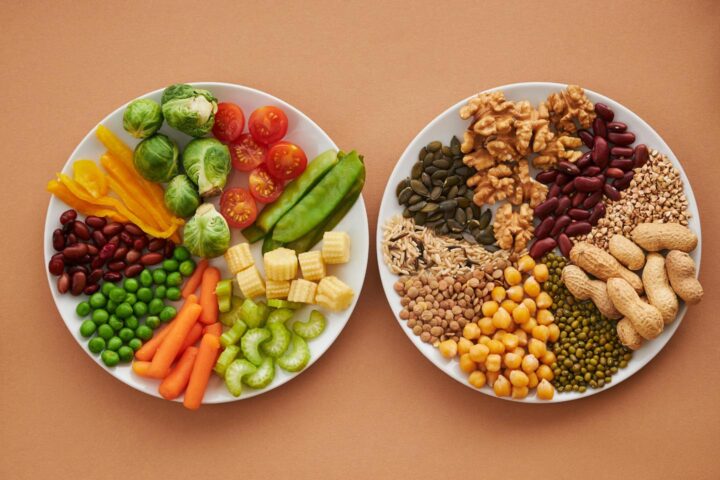
Recommendations include eating a wide variety of nutritious foods from the main five food groups:
- vegetables and legumes
- fruit
- grains
- lean meats and meat alternatives such as tofu, nuts and legumes
- dairy products.
The guidelines recommend limiting our intake of foods high in saturated fat, added salt, added sugars and alcohol.
What are Australians eating?
Fewer than 7% of Australians eat sufficient vegetables, in line with the Australian Dietary Guidelines.3)Australian Bureau of Statistics (2022), Dietary behaviour, ABS Website, accessed 30 January 2025. In fact, Australians have an average healthy diet score of 55 out of 100 – barely passing.4)Baird D, Hendrie G. CSIRO Healthy Diet Score 2015-2023 September 2023
Foods that aren’t part of a food group are known as “discretionary” items, which includes alcohol, cakes, biscuits, chocolate and confectionery and most takeaway foods. Because they’re typically high in calories, saturated fat, sodium and added sugars, the Australian Dietary Guidelines recommend they only be eaten occasionally and in small amounts (ideally zero serves).
For many households, discretionary items make up a big portion of their grocery shop. Australians consume an average of 28 serves of discretionary choices per week (equal to 28 doughnuts, 28 slices of cake, or 28 cans of soft drink or beer). This is an increase of ten serves since 2015.5)Baird D, Hendrie G. CSIRO Healthy Diet Score 2015-2023 September 2023
One recent study estimated 55% of Australians’ total energy intake was from discretionary items.6)Coyle, D.H., Huang, L., Shahid, M. et al. Socio-economic difference in purchases of ultra-processed foods in Australia: an analysis of a nationally representative household grocery purchasing panel. Int J Behav Nutr Phys Act 19, 148 (2022). https://doi.org/10.1186/s12966-022-01389-8
What did the researchers find?
Researchers from the Health Promotion Team at South West Healthcare recently visited four local supermarkets and takeaway stores in Warrnambool, Victoria, and purchased two baskets of groceries.7)HEALTHY DIETS ASAP PROCOTOL REPORT – WARRNAMBOOL CITY COUNCIL 2023
One basket met the Australian Dietary Guidelines (basket one), the other aligned with the typical dietary intake of Australians (basket two).
They compared prices between the two and found basket one would cost approximately $167 less per two week period for a family of four at the most affordable supermarket. That’s equal to $4,342 a year.
Basket one was sufficient to supply a family of four for two weeks, and aligned with the Australian Dietary Guidelines. It cost $724 and included:
- fruit and vegetables (made up 31% of the purchase)
- grains and cereals (oats, cornflakes, bread, rice, pasta, Weet-bix)
- lean meats and alternatives (mince, steak, chicken, tuna, eggs, nuts)8)Note of the redaction: Even lean meat is not really healthy, and avoiding meat altogether can increase the savings on the food bill even more.
- milk, yogurt and cheese
- oils and spreads (olive oil).

Basket two reflected the current average Australian two week purchase for a family of four.
In the project, the team spent over half of the shopping on processed and packaged foods, of which 21% was spent on take-away. This is based on actual dietary intake of the general population reported in the 2011-2012 Australian Health Survey.9)Australian Bureau of Statistics (December 2011), Australian Health Survey: Nutrition First Results – Foods and Nutrients, ABS Website, accessed 30 January 2025.
Basket two cost $891 and included:
- fruit and vegetables (made up 13% of the purchase)
- grains and cereals (oats, cornflakes, bread, rice, pasta, Weet-bix)
- lean meats and alternatives (mince, steak, chicken, tuna, eggs, nuts)
- milk, yogurt and cheese
- oils and spreads (olive oil, butter)
- drinks (soft drink, fruit juice)
- desserts and snacks (muffins, sweet biscuits, chocolate, ice cream, potato chips, muesli bars)
- processed meats (sausages, ham)
- convenience meals
- fast food (pizza, meat pie, hamburger, fish and chips)
- alcohol (beer, wine).
But a healthy basket is still unaffordable for many
While this piece of work, and other research, suggests a healthy diet is less expensive than an unhealthy diet, affordability is still a challenge for many families.10)Love P, Whelan J, Bell C, Grainger F, Russell C, Lewis M, Lee A. Healthy Diets in Rural Victoria—Cheaper than Unhealthy Alternatives, Yet Unaffordable. International Journal of Environmental Research and Public Health. 2018; 15(11):2469. https://doi.org/10.3390/ijerph15112469
The Warrnambool research found basket one (which aligned with guidelines) was still costly, requiring approximately 25% of a median household income.
This is unaffordable for many. For a household reliant on welfare, basket one would require allocating 26%-38% of their income. This highlights how the rising cost of living crisis is affecting those already facing financial difficulties.
Around 3.7 million Australian households did not have access to enough food to meet their basic needs at some point in the last 12 months.11)Foodbank Hunger Report 2023 https://reports.foodbank.org.au/foodbank-hunger-report-2023/
Policy action is needed from the Australian government to make recommended diets more affordable for low socioeconomic groups. This means lowering the costs of healthy foods and ensuring household incomes are sufficient.
What else can you do to cut your spending?
To help reduce food costs and support your health, reducing discretionary foods could be a good idea.
Other ways to reduce your grocery bill and keep your food healthy and fresh include:
- Planning for some meatless meals each week. Pulses (beans, lentils and legumes) are nutritious and cheap (a can is less than $1.50). Here are some great pulse recipes to try.
- Checking the specials and buy in bulk (to store or freeze) when items are cheaper.
- Making big batches of meals and freezing them. Single-serve portions can help save time for lunches at work, saving on takeaway.
- Australian supermarkets are almost never the cheapest place for fresh produce, so shop around for farmers markets or smaller local grocery shops.12)Evershed N, Rachwani M. Revealed: major Australian supermarkets almost never the cheapest place for your fresh produce. The Guardian, July 26, 2023
- Buying generic brands when possible, as they are notably cheaper.13)Zorbas C, Lee A, Peeters A, Lewis M, Landrigan T, Backholer K. Streamlined data-gathering techniques to estimate the price and affordability of healthy and unhealthy diets under different pricing scenarios. Public Health Nutrition. 2021;24(1):1-11. doi:10.1017/S1368980020001718 Supermarkets usually promote the items they want you to buy at eye-level, so check the shelves above and below for cheaper alternatives.14)Kendall G. The science that makes us spend more in supermarkets, and feel good while we do it. The Conversation, March 4, 2014

Stay Always Up to Date
Sign up to our newsletter and stay always informed with news and tips around your health.
This article is republished from The Conversation under a Creative Commons license. Read the original article.


Emily Burch is an Accredited Practicing Dietitian and Lecturer at Southern Cross University. She holds a PhD in Type 2 Diabetes and her current research is dedicated to enhancing the quality of care for people living with diabetes in both the Australian private and public health sectors.

Lauren has an international reputation for improving health care by creating knowledge, translating it into real-life scenarios, and evaluating improvements for people, providers, and funders. Her work spans general practice, community care, aged care, allied health, workforce development, digital health, and population health.
References
| ↑1, ↑7 | HEALTHY DIETS ASAP PROCOTOL REPORT – WARRNAMBOOL CITY COUNCIL 2023 |
|---|---|
| ↑2 | Murray, Christopher J L et al. Global burden of 87 risk factors in 204 countries and territories, 1990–2019: a systematic analysis for the Global Burden of Disease Study 2019. The Lancet, Volume 396, Issue 10258, 1223 – 1249 https://doi.org/10.1016/S0140-6736(20)30752-2 |
| ↑3 | Australian Bureau of Statistics (2022), Dietary behaviour, ABS Website, accessed 30 January 2025. |
| ↑4, ↑5 | Baird D, Hendrie G. CSIRO Healthy Diet Score 2015-2023 September 2023 |
| ↑6 | Coyle, D.H., Huang, L., Shahid, M. et al. Socio-economic difference in purchases of ultra-processed foods in Australia: an analysis of a nationally representative household grocery purchasing panel. Int J Behav Nutr Phys Act 19, 148 (2022). https://doi.org/10.1186/s12966-022-01389-8 |
| ↑8 | Note of the redaction: Even lean meat is not really healthy, and avoiding meat altogether can increase the savings on the food bill even more. |
| ↑9 | Australian Bureau of Statistics (December 2011), Australian Health Survey: Nutrition First Results – Foods and Nutrients, ABS Website, accessed 30 January 2025. |
| ↑10 | Love P, Whelan J, Bell C, Grainger F, Russell C, Lewis M, Lee A. Healthy Diets in Rural Victoria—Cheaper than Unhealthy Alternatives, Yet Unaffordable. International Journal of Environmental Research and Public Health. 2018; 15(11):2469. https://doi.org/10.3390/ijerph15112469 |
| ↑11 | Foodbank Hunger Report 2023 https://reports.foodbank.org.au/foodbank-hunger-report-2023/ |
| ↑12 | Evershed N, Rachwani M. Revealed: major Australian supermarkets almost never the cheapest place for your fresh produce. The Guardian, July 26, 2023 |
| ↑13 | Zorbas C, Lee A, Peeters A, Lewis M, Landrigan T, Backholer K. Streamlined data-gathering techniques to estimate the price and affordability of healthy and unhealthy diets under different pricing scenarios. Public Health Nutrition. 2021;24(1):1-11. doi:10.1017/S1368980020001718 |
| ↑14 | Kendall G. The science that makes us spend more in supermarkets, and feel good while we do it. The Conversation, March 4, 2014 |
Leave a Reply