They are too fat. No question about it. Who, or what are too fat? Our children—more than one in five grade-school children and adolescents in the United States are so fat as to be actually termed obese. Really, this should not come as a surprise to anyone who takes note of gatherings of children, for seeing, in this case, is believing.
To make it worse, these figures are steadily increasing since the mid-1960’s—54% more obesity in children 6-11 years old, and almost 40% more in adolescents.1)Queen PM and Lang CE. Handbook of Pediatric Nutrition, An Aspen Publication, Gaithersburg, Maryland, 1993, pp 187-203, 560-572.
To think that this fatness will level off as the children grow up is to believe a myth—many obese children grow on into obese adults, and childhood obesity seems to be high where adult obesity is common. In fact, there is evidence that obesity in parents is an important predictor of a child’s risk of carrying obesity into adulthood.2)Whitaker RC et al. Predicting Obesity in Young Adulthood from Childhood and Parental Obesity. N Eng J Med, 337:86973, 1997.
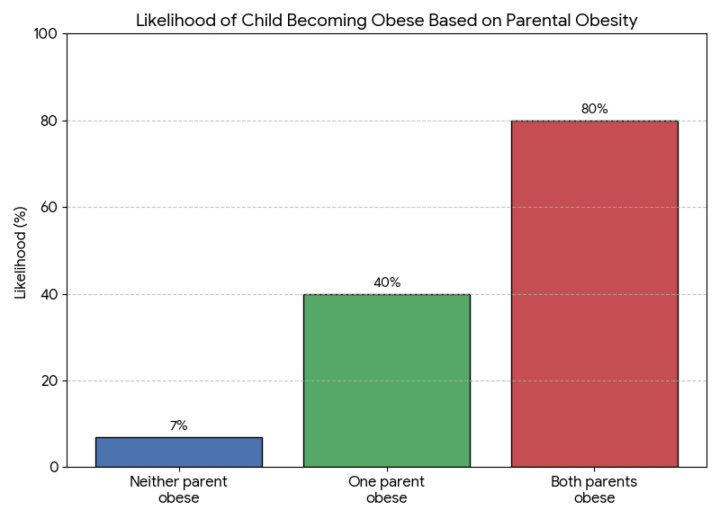
Apparently the risk of obesity is significantly greater if either the mother or the father is obese, probably because of hereditary factors or of environmental factors within families. If both parents are obese there is an 80% chance of their child’s becoming obese. The likelihood drops to 40% if one parent is obese, and 7% if neither is obese.3)Watson RR and Eisinger M. Exercise and Disease, CRC Press, Inc., Boca Raton, FL, 1992, pp 1-10.
When is a Child Obese?
A child is obese when he or she has an excess baggage of adipose tissue containing stored fat. As simple as that. Scientists define overweight in childhood as a body mass index (BMI) in the 85th percentile for that child’s age and sex.
This means that if 100 average “normal” children of the same age and sex are lined up by weights, this child would be number 85 or higher. For Obesity it would be number 95 or higher. Alternatively he/she is obese when the triceps skin fold (the width of the fold of skin produced when you pinch up the skin and attached flesh at the back of the upper arm between your thumb and index finger) exceeds the 85th percentile.4)Queen PM and Lang CE. Handbook of Pediatric Nutrition, An Aspen Publication, Gaithersburg, Maryland, 1993, pp 187-203, 560-572.
Health Risks and Economic Costs
This obesity in childhood, which tends towards obesity in adults, is likely to increase the cost of treatment, of illness and death from high blood pressure, insulin resistance, impaired ability to handle sugar, or diabetes mellitus, gout, cancer, and cardiovascular disease. Conservative estimates of the economic costs of obesity are 3–8% of total health care expenditure in countries such as Finland, the Netherlands, France, the USA, Australia and Sweden—proportions at least as great as those for all cancers or for AIDS. Obesity costs money.5)Bjornotorp P. Obesity. Lancet, 350:423-26, 1997.
What Causes Obesity?
The precise causes of obesity are not well understood. There are many related factors such as social and psychological factors, and lack of physical activity. The marital status of the parents influences the occurrence of obesity as well as the rate of weight loss in children in treatment programs.6)Queen PM and Lang CE. Handbook of Pediatric Nutrition, An Aspen Publication, Gaithersburg, Maryland, 1993, pp 187-203, 560-572.
Nevertheless, it is generally understood that obesity results when anyone eats more food than is used up in activity of one kind or another. Thus, one who eats more calories than he spends in energy will store them as fat. In addition, eating too much high-fat food seems to be of special significance, not only because fat packs many more calories than do other nutrients, but also because intake seems to be very poorly regulated.7)Bjornotorp P. Obesity. Lancet, 350:423-26, 1997.
It has been clear for a long time that genetic factors are involved in causing obesity. Special attention is now being given to leptin, a protein produced only in fatty tissue, that signals the brain that enough has been eaten. Some scientists think that maybe some obese people are fat because they have fat cells that are not secreting appropriate quantities of leptin; thus, the brain is not getting the signal to stop eating. However, leptin seems to be of limited interest for causing obesity in man, and further investigation is needed.8)Bjornotorp P. Obesity. Lancet, 350:423-26, 1997.
How Can Obesity be Prevented and/or Treated?
Obesity in children and adolescents requires special attention. The medical illnesses associated with obesity usually occur in adulthood, and obesity that has persisted throughout childhood is more difficult to treat. Although little research has been done on the prevention of obesity in childhood, indirect evidence indicates that the prevention of obesity and effective treatment of overweight children are essential.
The basis of treatment is to secure a negative energy balance-meaning that more energy must be used up in activity than is taken in by food. Dietary treatment should aim at modest reductions in food eaten, by eliminating snacks and by limiting portion sizes of calorie-rich foods. Ready-prepared foods should be limited, because these often have a high fat content.9)Bjornotorp P. Obesity. Lancet, 350:423-26, 1997.
A combination of exercise and diet is more effective than either alone. Children should normally be physically active, and activity should be especially encouraged in an obese child. General activity and play is better than competitive sports. Walking or biking three, or better, five times a week, for 30 minutes or longer is recommended.10)Queen PM and Lang CE. Handbook of Pediatric Nutrition, An Aspen Publication, Gaithersburg, Maryland, 1993, pp 187-203, 560-572.
Reducing inactivity is important too. Television, computers, and video games have been found to be associated with obesity in children. Children aged 2 to 5 years old are around 20 hours per week in front of screens. Increased television viewing is a risk factor for obesity for a number of reasons. First, eating high-energy snacks promotes general inactivity. Second, television promotes viewing snack foods, then eating more snack foods.11)Watson RR and Eisinger M. Exercise and Disease, CRC Press, Inc., Boca Raton, FL, 1992, pp 1-10.
Parental attitude is involved in the prevention of childhood obesity. The purchase and serving of food, and the role model that the parent provides with his/her own food and exercise habits have a positive impact on children in reducing the prevalence of obesity in childhood. Also, the child’s school may have a role in teaching healthful food and exercise habits. Having a curriculum that provides nutrition information could enable coaches, teachers, parents, and students to achieve normal nutritional needs for children, as well as guidance for the preparation of a healthful diet. Physical education classes (or physical activity) such as running, hiking, cycling, or swimming should be provided on a regular basis. The future well-being of our nation may, to a much greater extent than we realize, depend on the eating and exercise habits we develop in our children.

Stay Always Up to Date
Sign up to our newsletter and stay always informed with news and tips around your health.
This article was published originally in the Journal of Health and Healing, a publication of Wildwood Institute.

Dr. Dahlia Ferilina was a graduate student at Andrews University when she wrote this article.
References
| ↑1, ↑4, ↑6, ↑10 | Queen PM and Lang CE. Handbook of Pediatric Nutrition, An Aspen Publication, Gaithersburg, Maryland, 1993, pp 187-203, 560-572. |
|---|---|
| ↑2 | Whitaker RC et al. Predicting Obesity in Young Adulthood from Childhood and Parental Obesity. N Eng J Med, 337:86973, 1997. |
| ↑3, ↑11 | Watson RR and Eisinger M. Exercise and Disease, CRC Press, Inc., Boca Raton, FL, 1992, pp 1-10. |
| ↑5, ↑7, ↑8, ↑9 | Bjornotorp P. Obesity. Lancet, 350:423-26, 1997. |
Leave a Reply