Antioxidants are a commonly promoted feature of health foods and supplements. They’re portrayed as the good forces that fight free radicals – nasty molecules causing damage thought to hasten aging and cause chronic diseases.
The simple logic that antioxidants are “good” and free radicals are “bad”, has led to the idea that simply getting more antioxidants into our bodies, from foods or supplements, can outweigh the impacts of free radicals.
Sadly, biology is never this simple, and antioxidants are not a free radical free pass.
We are exposed to free radicals every day; they’re produced in our bodies as part of normal functioning. Such normal levels are easily tolerated.
But habits such as smoking, drinking, and eating processed foods all increase exposure. These additional free radicals may increase the risk of lifestyle and age-related diseases, such as cancer and cardiovascular disease.
Free radicals explained
Free radicals are very reactive molecules. In the body, a chemical reaction occurs between free radicals and the molecules that make up our cells.
This inactivates the free radical, but turns the other molecule into a new free radical. The process continues in a chain reaction, damaging each molecule as it goes on.
These reactions can alter the structure and function of molecules; when enough molecules are damaged, cells can stop functioning correctly, or die.
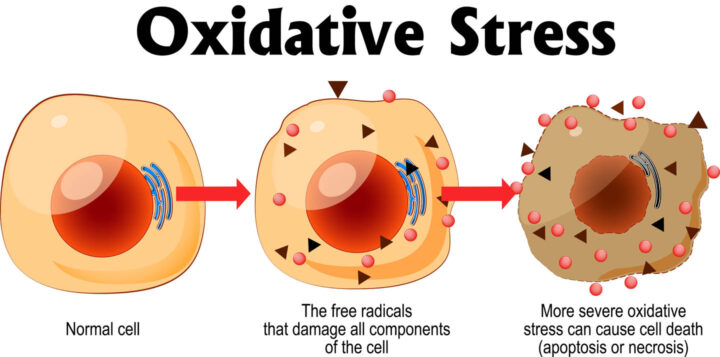
Damage to DNA by free radicals can result in mutations and promote cancer. Free radicals can also oxidize low-density lipoprotein or LDL (“bad” cholesterol), making it more likely to get trapped on the artery walls, clogging blood vessels and leading to cardiovascular disease.1)Yoshida H, Kisugi R. Mechanisms of LDL oxidation. Clin Chim Acta. 2010 Dec 14;411(23-24):1875-82. doi: 10.1016/j.cca.2010.08.038.
Sometimes, free radicals are very helpful, for example, in an oxidative burst.2)Respiratory Burst. Wikipedia This happens when special immune cells, known as phagocytes, deliberately release free radicals as part of a cocktail of chemicals to kill and digest bacteria and viruses.
Our antioxidant heroes
Antioxidants can stop the free radical chain reaction. They can react with free radicals without getting damaged or becoming a free radical themselves.
There are hundreds of substances that can act as antioxidants. Well-known antioxidants include vitamin C and vitamin E, both of which are found in fruits and vegetables.
Vitamin C is mainly found in citrus fruits and berries, while vitamin E is abundant in nuts and green leafy vegetables.
The ability of antioxidants to scavenge free radicals has led to the suggestion that consuming large amounts of antioxidants might lessen the free radical damage that leads to chronic diseases and aging.3)Pala FS et.al. The role of free radicals in ethiopathogenesis of diseases. Advances in Molecular Biology (1): 1-9, 2008
Harman D. The Free Radical Theory of Aging. https://doi.org/10.1089/152308603770310202
And there’s little doubt that a diet including sources of antioxidants is necessary for good health. Indeed, studies have shown that cancer rates are lower in people with diets rich in fruits and vegetables.4)Block G, Patterson B, Subar A. Fruit, vegetables, and cancer prevention: a review of the epidemiological evidence. Nutr Cancer. 1992;18(1):1-29. doi: 10.1080/01635589209514201.
Not all roses
But the benefits of supplementing diets with additional antioxidants are yet to be shown. In fact, some studies have shown that taking antioxidant supplements can sometimes increase the risk of cancer.5)Bardia A, et.al. Efficacy of Antioxidant Supplementation in Reducing Primary Cancer Incidence and Mortality: Systematic Review and Meta-analysis, Mayo Clinic Proceedings, Volume 83, Issue 1, 2008, Pages 23-34, ISSN 0025-6196, https://doi.org/10.4065/83.1.23.
This might be because antioxidants may be actually harmful under certain conditions. At high concentrations, substances that normally act as antioxidants can have the opposite effect and act as a pro-oxidant. This may be because antioxidants compounds, such as vitamin C, react with other molecules in the body, not just free radicals.6)Podmore, I., Griffiths, H., Herbert, K. et al. Vitamin C exhibits pro-oxidant properties. Nature 392, 559 (1998). https://doi.org/10.1038/33308
Some of these reactions, such as the Fenton Reaction, actually produce additional free radicals.7)Carr, A. and Frei, B. (1999), Does vitamin C act as a pro-oxidant under physiological conditions?. The FASEB Journal, 13: 1007-1024. https://doi.org/10.1096/fasebj.13.9.1007 When antioxidant concentrations get too high, the free radical-producing effect can outweigh the free radical-fighting effect.
Also, not all antioxidants are the same; each has unique chemical behaviors and biological properties. This means that no single substance can replace the multiple functions of a variety of antioxidants.
A growth industry
Despite these uncertainties about their efficacy, supplemental antioxidants are a boom industry, sold as a health panacea and added to a range of processed foods, including juices, cereals, chocolate bars, and alcoholic beverages.
But the benefits of antioxidant-rich food is likely due to the entire nutritional package that comes from a diet rich in natural and whole foods. Adding antioxidants to processed foods means many healthy components of whole foods are missing.
So it’s unlikely that antioxidant supplements will be as successful in preventing disease as a healthy, varied and balanced diet. And while antioxidants may help protect the body from free-radical damage, as is often the case in nutrition, more is not always better.
The myriad other components of foods that are natural sources of antioxidants may also be responsible for their beneficial effects.
The best thing you can do for good health is to keep eating between five and eight servings of fruit or vegetables every day and to steer clear of unnecessary, and potentially harmful supplementation.

Stay Always Up to Date
Sign up to our newsletter and stay always informed with news and tips around your health.
This article is republished from The Conversation under a Creative Commons license. Read the original article.


Emma has a multi-faceted research background, with qualifications and experience in food science, nutrition, epidemiology, science management, biomedical sciences, immunology and microbiology. Her research focuses on molecular nutrition. Emma is also a passionate science communicator. She has written for newspapers and magazines, and appears regularly on local and national radio.

Mark is an Associate Professor of Human Molecular Nutrition at the University of Newcastle. His areas of research and interest include vitamin-related nutrient-gene interactions in the context of the human lifecycle, health and disease.
References
| ↑1 | Yoshida H, Kisugi R. Mechanisms of LDL oxidation. Clin Chim Acta. 2010 Dec 14;411(23-24):1875-82. doi: 10.1016/j.cca.2010.08.038. |
|---|---|
| ↑2 | Respiratory Burst. Wikipedia |
| ↑3 | Pala FS et.al. The role of free radicals in ethiopathogenesis of diseases. Advances in Molecular Biology (1): 1-9, 2008 Harman D. The Free Radical Theory of Aging. https://doi.org/10.1089/152308603770310202 |
| ↑4 | Block G, Patterson B, Subar A. Fruit, vegetables, and cancer prevention: a review of the epidemiological evidence. Nutr Cancer. 1992;18(1):1-29. doi: 10.1080/01635589209514201. |
| ↑5 | Bardia A, et.al. Efficacy of Antioxidant Supplementation in Reducing Primary Cancer Incidence and Mortality: Systematic Review and Meta-analysis, Mayo Clinic Proceedings, Volume 83, Issue 1, 2008, Pages 23-34, ISSN 0025-6196, https://doi.org/10.4065/83.1.23. |
| ↑6 | Podmore, I., Griffiths, H., Herbert, K. et al. Vitamin C exhibits pro-oxidant properties. Nature 392, 559 (1998). https://doi.org/10.1038/33308 |
| ↑7 | Carr, A. and Frei, B. (1999), Does vitamin C act as a pro-oxidant under physiological conditions?. The FASEB Journal, 13: 1007-1024. https://doi.org/10.1096/fasebj.13.9.1007 |
Leave a Reply