They’re known as ‘oily fruits’. Because of their numerous health benefits, notwithstanding their high fat content, almonds, hazelnuts and other nuts are among foods recommended for consumption in Canada, the US, and across the EU – to the tune of a small handful each day.1)Anderson TJ, et. al. 2016 Canadian Cardiovascular Society Guidelines for the Management of Dyslipidemia for the Prevention of Cardiovascular Disease in the Adult. Can J Cardiol. 2016 Nov;32(11):1263-1282. doi: 10.1016/j.cjca.2016.07.510.
U.S. Department of Health and Human Services and U.S. Department of Agriculture. 2015 – 2020 Dietary Guidelines for Americans. 8th Edition. December 2015. Available at https://health.gov/our-work/food-nutrition/previous-dietary-guidelines/2015.
EU Science Hub: https://joint-research-centre.ec.europa.eu/orphan-pages/page/health-promotion-and-disease-prevention/food-based-dietary-guidelines-europe_en
From a nutritional standpoint, these hard-shelled fruits are distinguished by high levels (50-75%) of unsaturated fats (which are seen as ‘good fats’), significant protein content (10-25%), plus minerals (sodium, magnesium, potassium), vitamins B3, B9, B6 and E, fiber, antioxidants and vegetable oils. A stack of data suggests that they could help us age well and protect us from a range of chronic conditions.
Stripping out ‘bad’ cholesterol
If there’s one area where shelled fruits have proved their worth, it’s bringing cholesterol down. Reducing the amount of animal fat in your diet and eating fiber are, for certain, effective ways to cut levels of LDL-cholesterol, that’s to say ‘bad cholesterol’. But many studies have also shown the benefits of a daily handful of almonds. The same seems true of all nuts.
In 2010, a study of the collected data over the course of 25 clinical trials involving men and women with high cholesterol showed that eating 67g of nuts every day for 3-8 weeks could cut LDL-C levels by 7.4%, with more sizeable effects than this on symptoms since the patients were over healthy limits previously.2)Sabaté J, Oda K, Ros E. Nut consumption and blood lipid levels: a pooled analysis of 25 intervention trials. Arch Intern Med. 2010 May 10;170(9):821-7. doi: 10.1001/archinternmed.2010.79.
Another systematic data review confirmed this, albeit at a more modest rate. Carried out in 2018, it analysed results from 26 clinical trials: the authors in this case detected a 3.7% fall in LDL-C levels for a diet rich in shelled fruits (15-108g per day) over a period of one to 12 months.3)Guasch-Ferré M, Li J, Hu FB, Salas-Salvadó J, Tobias DK. Effects of walnut consumption on blood lipids and other cardiovascular risk factors: an updated meta-analysis and systematic review of controlled trials. Am J Clin Nutr. 2018 Jul 1;108(1):174-187. doi: 10.1093/ajcn/nqy091. It’s known that lowering LDL-C levels is linked to a reduction in total mortality and in deaths from cardiovascular disease, particularly if levels were high to start with.4)Navarese EP, et.al. Association Between Baseline LDL-C Level and Total and Cardiovascular Mortality After LDL-C Lowering: A Systematic Review and Meta-analysis. JAMA. 2018 Apr 17;319(15):1566-1579. doi: 10.1001/jama.2018.2525. Even if no clinical study has yet shown that eating nuts can reduce the risk of heart failure, there’s no shortage of arguments to support such a hypothesis.
Lower risk of cardiovascular disease
First one might point to the results of a meta-analysis published in 2019. Applying the criteria used by Canada’s Cochrane Centre, the authors chose 19 studies, and evaluated that a 28g daily portion of nuts is associated with a 13% fall in cardiovascular disease, and 29% in deaths from heart disease.5)Becerra-Tomás N, Paz-Graniel I, W C Kendall C, Kahleova H, Rahelić D, Sievenpiper JL, Salas-Salvadó J. Nut consumption and incidence of cardiovascular diseases and cardiovascular disease mortality: a meta-analysis of prospective cohort studies. Nutr Rev. 2019 Oct 1;77(10):691-709. doi: 10.1093/nutrit/nuz042.
You could also refer to a huge randomized and controlled study across many different locations on the role of a Mediterranean diet enriched with nuts in reducing the risk of heart disease. Participants in this, aged 55-80 and registering a significant risk of heart disease were assigned one of three diets – low-fat, a Mediterranean diet rich in olive oil, and a Mediterranean diet with added nuts. They were tracked for almost 5 years on average. At the end of the research, it was shown that heart problems were less frequent among the two groups following the Mediterranean diet.6)Estruch R, et. al. PREDIMED Study Investigators. Primary Prevention of Cardiovascular Disease with a Mediterranean Diet Supplemented with Extra-Virgin Olive Oil or Nuts. N Engl J Med. 2018 Jun 21;378(25):e34. doi: 10.1056/NEJMoa1800389.
Fat that doesn’t make you put on weight
On the energy side, 30g of almonds, peanuts, pistachios or cashews work out as a 180 calorie snack; the same quantity of pecans or Brazil nuts come to 220-230 calories. These figures are roughly equivalent to 30-40g of milk chocolate. Since the calorific content is essentially made up of fats, one might be given to think one must beware of ‘oily fruits’ if weight-watching. But that assumption would be wrong…
In fact, a recent piece of research closely analysed six cohort studies and 62 randomized diet tests. This concluded that regularly eating nuts for a longer or shorter period of time (between 3 and 336 weeks) is linked to very slight weight loss (an average of 200g) and a shrinking waistline (by an average of 0.5cm).7)Li H, Li X, Yuan S, Jin Y, Lu J. Nut consumption and risk of metabolic syndrome and overweight/obesity: a meta-analysis of prospective cohort studies and randomized trials. Nutr Metab (Lond). 2018 Jun 22;15:46. doi: 10.1186/s12986-018-0282-y.
If the reasons for these counter-intuitive outcomes haven’t been adequately explained yet, various theories can be put forward. For one, the matrix that encases the oils in nuts limits, to an extent, their absorption in the gut. To put it simply – some of the fat content in nuts is eliminated in the body’s cells, rather than being absorbed. Meanwhile, thanks to how they blunt our appetite, almonds and other nuts reduce the amount we eat at meals, so much so that our overall calorie count is no greater, or perhaps less than it would have been without them.
Do nuts have anti-cancer properties?
Other benefits are attributed to shelled fruits – notably around cancer prevention, although the evidence for this is weak. The relevant studies rely on observations alone, and suffer from various interpretation biases.
Thus, according to an analysis of 33 studies published before June 2019, increased consumption of nuts is demonstrably linked to a 10% fall in cancer risk; and the effect is more marked for cancers of the digestive system, with a risk reduction of 17%.
Nuts’ high antioxidant content might be one of the drivers for this. But before exploring this hypothesis further, we need to check the observed data with verifiable controlled and randomised clinical trials. For the moment, there’s nothing that allows us to say that eating nuts protects against cancer.
Fewer neurodegenerative conditions
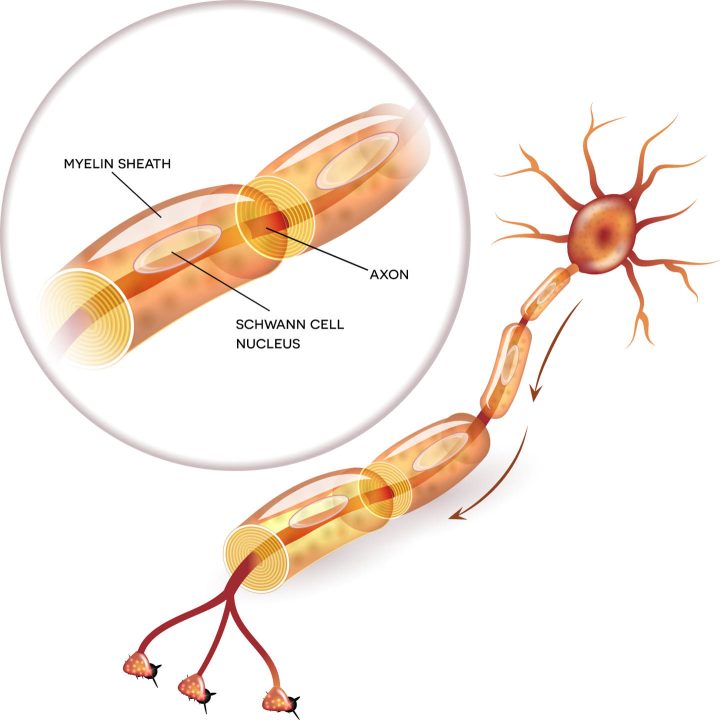
Oils and fats are vital for the brain. After fat tissue, it’s the organ in the body richest in lipids: they can be found in the neuron membranes and related cells, but also in the myelin which speeds up the transmission of electrical impulses through the nervous system.
Several research teams have set out to evaluate the benefits of nuts for the central nervous system. What have they learned?8)Carey A. et.al. The beneficial effects of tree nuts on the aging brain. Nutrition and Aging 1 (2012) 55–67 DOI 10.3233/NUA-2012-0007
Their notable discovery was that after a few weeks of a diet more or less rich in nuts, 19 month-old rats performed better on psychometric tests.9)Willis LM, Shukitt-Hale B, Cheng V, Joseph JA. Dose-dependent effects of walnuts on motor and cognitive function in aged rats. Br J Nutr. 2009 Apr;101(8):1140-4. doi: 10.1017/S0007114508059369. A diet of 2% nuts boosted their performance on a rod-clambering test, one of 6% nuts saw them do better on a plank-walking test, and at both these levels their powers of short term memory were heightened. These results have been confirmed by a study of shorter duration, with a marked improvement detectable in the rodents’ learning and memory.10)Haider S, Batool Z, Tabassum S, Perveen T, Saleem S, Naqvi F, Javed H, Haleem DJ. Effects of walnuts (Juglans regia) on learning and memory functions. Plant Foods Hum Nutr. 2011 Nov;66(4):335-40. doi: 10.1007/s11130-011-0260-2.
As for humans, a study of the PREDIMED diet intervention has shown that a Mediterranean diet rich in nuts improves short-term memory.11)Valls-Pedret C, Lamuela-Raventós RM, Medina-Remón A, Quintana M, Corella D, Pintó X, Martínez-González MÁ, Estruch R, Ros E. Polyphenol-rich foods in the Mediterranean diet are associated with better cognitive function in elderly subjects at high cardiovascular risk. J Alzheimers Dis. 2012;29(4):773-82. doi: 10.3233/JAD-2012-111799. It has also offered evidence, at a biological level, of a reduced risk of low BDNF plasma – a protein which helps the growth and vigour of new neurons.12)Sánchez-Villegas A, Galbete C, Martinez-González MA, Martinez JA, Razquin C, Salas-Salvadó J, Estruch R, Buil-Cosiales P, Martí A. The effect of the Mediterranean diet on plasma brain-derived neurotrophic factor (BDNF) levels: the PREDIMED-NAVARRA randomized trial. Nutr Neurosci. 2011 Sep;14(5):195-201. doi: 10.1179/1476830511Y. Nuts seem to have a beneficial role at warding off age-related cognitive decline. However, we don’t have direct proof that if one regularly eats nuts, it reduces the risk of neurodegenerative diseases.
To sum up: nuts appear at first glance to have all the features allowing them to be considered allies of our health. While they are calorie-rich and high in fats, a 30g serving per day seems to cut “bad cholesterol” and protect us from cardiovascular disease, without affecting our weight. There are plenty of theories that suggest they a positive impact, both on other illnesses and warding off cognitive decline associated with age.
Plenty of good reasons to recommend everyone to include a handful of almonds, hazelnuts or other nuts in the food they eat each day – obviously without added sugar or salt!

Stay Always Up to Date
Sign up to our newsletter and stay always informed with news and tips around your health.
This article is republished from The Conversation under a Creative Commons license. Read the original article.


Prof. Boris Hansel is Professor of Nutrition at the University of Paris, and an endocrinologist. He has also a few leadership functions in departments of various hospitals. Boris Hansel hosts the PuMS channel, the university health program for the general public, and their Youtube Channel.

Diana is hospital practitioner at the Diabetology-Nutrition Department at Hôpital Bichat, Lecturer in the Nutrition Department of Université Paris Cité

Jérémy is Assistant Specialist at the Diabetology-Nutrition Department at Hôpital Bichat, and Lecturer in the Nutrition Department of Université Paris Cité
References
| ↑1 | Anderson TJ, et. al. 2016 Canadian Cardiovascular Society Guidelines for the Management of Dyslipidemia for the Prevention of Cardiovascular Disease in the Adult. Can J Cardiol. 2016 Nov;32(11):1263-1282. doi: 10.1016/j.cjca.2016.07.510. U.S. Department of Health and Human Services and U.S. Department of Agriculture. 2015 – 2020 Dietary Guidelines for Americans. 8th Edition. December 2015. Available at https://health.gov/our-work/food-nutrition/previous-dietary-guidelines/2015. EU Science Hub: https://joint-research-centre.ec.europa.eu/orphan-pages/page/health-promotion-and-disease-prevention/food-based-dietary-guidelines-europe_en |
|---|---|
| ↑2 | Sabaté J, Oda K, Ros E. Nut consumption and blood lipid levels: a pooled analysis of 25 intervention trials. Arch Intern Med. 2010 May 10;170(9):821-7. doi: 10.1001/archinternmed.2010.79. |
| ↑3 | Guasch-Ferré M, Li J, Hu FB, Salas-Salvadó J, Tobias DK. Effects of walnut consumption on blood lipids and other cardiovascular risk factors: an updated meta-analysis and systematic review of controlled trials. Am J Clin Nutr. 2018 Jul 1;108(1):174-187. doi: 10.1093/ajcn/nqy091. |
| ↑4 | Navarese EP, et.al. Association Between Baseline LDL-C Level and Total and Cardiovascular Mortality After LDL-C Lowering: A Systematic Review and Meta-analysis. JAMA. 2018 Apr 17;319(15):1566-1579. doi: 10.1001/jama.2018.2525. |
| ↑5 | Becerra-Tomás N, Paz-Graniel I, W C Kendall C, Kahleova H, Rahelić D, Sievenpiper JL, Salas-Salvadó J. Nut consumption and incidence of cardiovascular diseases and cardiovascular disease mortality: a meta-analysis of prospective cohort studies. Nutr Rev. 2019 Oct 1;77(10):691-709. doi: 10.1093/nutrit/nuz042. |
| ↑6 | Estruch R, et. al. PREDIMED Study Investigators. Primary Prevention of Cardiovascular Disease with a Mediterranean Diet Supplemented with Extra-Virgin Olive Oil or Nuts. N Engl J Med. 2018 Jun 21;378(25):e34. doi: 10.1056/NEJMoa1800389. |
| ↑7 | Li H, Li X, Yuan S, Jin Y, Lu J. Nut consumption and risk of metabolic syndrome and overweight/obesity: a meta-analysis of prospective cohort studies and randomized trials. Nutr Metab (Lond). 2018 Jun 22;15:46. doi: 10.1186/s12986-018-0282-y. |
| ↑8 | Carey A. et.al. The beneficial effects of tree nuts on the aging brain. Nutrition and Aging 1 (2012) 55–67 DOI 10.3233/NUA-2012-0007 |
| ↑9 | Willis LM, Shukitt-Hale B, Cheng V, Joseph JA. Dose-dependent effects of walnuts on motor and cognitive function in aged rats. Br J Nutr. 2009 Apr;101(8):1140-4. doi: 10.1017/S0007114508059369. |
| ↑10 | Haider S, Batool Z, Tabassum S, Perveen T, Saleem S, Naqvi F, Javed H, Haleem DJ. Effects of walnuts (Juglans regia) on learning and memory functions. Plant Foods Hum Nutr. 2011 Nov;66(4):335-40. doi: 10.1007/s11130-011-0260-2. |
| ↑11 | Valls-Pedret C, Lamuela-Raventós RM, Medina-Remón A, Quintana M, Corella D, Pintó X, Martínez-González MÁ, Estruch R, Ros E. Polyphenol-rich foods in the Mediterranean diet are associated with better cognitive function in elderly subjects at high cardiovascular risk. J Alzheimers Dis. 2012;29(4):773-82. doi: 10.3233/JAD-2012-111799. |
| ↑12 | Sánchez-Villegas A, Galbete C, Martinez-González MA, Martinez JA, Razquin C, Salas-Salvadó J, Estruch R, Buil-Cosiales P, Martí A. The effect of the Mediterranean diet on plasma brain-derived neurotrophic factor (BDNF) levels: the PREDIMED-NAVARRA randomized trial. Nutr Neurosci. 2011 Sep;14(5):195-201. doi: 10.1179/1476830511Y. |
Leave a Reply